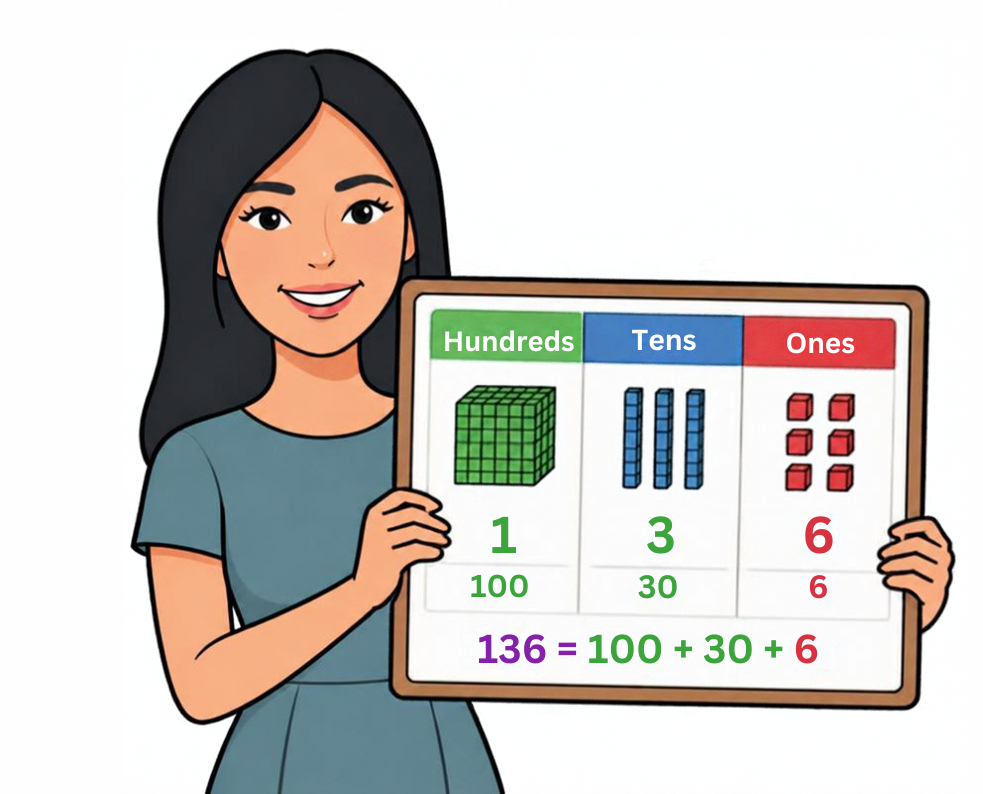
Place value is one of those first grade concepts that quietly decides how the rest of math goes. A child who truly understands that 43 is 4 tens and 3 ones, not just two symbols sitting next to each other, has the foundation for adding, subtracting, regrouping, and everything that follows. A child who is still counting by ones is working twice as hard for years. That is why we are so excited to share this one, and to share it free.
We teamed up with Miss Jaeme, a first grade teacher, to build a complete place value curriculum guide around our Magnetic Base Ten Place Value Frame Set. She designed it in her own classroom, with her own little learners, and it shows. As she put it, "It's easy on the eyes and easy to use. Nothing is too busy or distracting, which is exactly what my little learners need."
Why place value needs to be seen and touched
First graders learn place value best when they can see a number and hold it at the same time. That is the whole idea behind this guide. The magnetic frame is the visual anchor, showing every student exactly where tens and ones belong, the same way, every single time. The base ten pieces are the hands-on part, so students physically build, trade, add, and take away. When both happen together, a number stops being an abstract symbol and becomes a quantity a child can count, move, and prove. The consistency matters too: because the model never changes, students can focus on the math instead of decoding a new picture every day.
What is inside the guide
This is a full 22-page curriculum, not a worksheet packet. It includes four units that carry a first grader through the year: Counting On and Making Ten, Tens and Ones, Adding and Subtracting to 100, and Skip Counting and Number Patterns. Each unit comes with clear goals, learning objectives, hands-on activities, and a ready-to-teach sample lesson plan laid out minute by minute.
It is also built to fit the math you may already be teaching. The guide includes Eureka Math² connections that show where each unit lines up in the Grade 1 sequence, along with a simple breakdown of how to use the frame during each part of a lesson. Every unit lists specific standards, drawn from the California Common Core State Standards for Mathematics and the Standards for Mathematical Practice, plus ELA speaking and listening, Head Start ELOF, and SEL competencies.
You will also find a dedicated small groups and intervention section, with a "support by skill" troubleshooting guide for common first grade stumbling blocks, sensory supports for every learner, cross-curricular connections, a home connection for families, six printable worksheets, free online resources, and a care and maintenance guide.
Made with real classrooms in mind
A few things set this guide apart. It is grounded in a clean, low-distraction design, which helps students who are easily overwhelmed keep their attention on the numbers. It is full of movement, with children stomping by tens, standing for ten more, and crouching for ten less, so the math lives in the body as well as the mind. And it is genuinely flexible: the frame sticks and unsticks in seconds, so the exact model students see at the board comes right to the teacher table for small group work, and the whole guide is written for Grade 1 but adaptable for kindergarten and second grade.
Grab it free
You can download the full Magnetic Base Ten Place Value Frame Set First Grade Curriculum Guide right here, at no cost. Print it, use it, and share it with a teacher or homes educator friend who could use it too.
A huge thank you to Miss Jaeme for building this and letting us share it with our community. If you use the guide in your classroom or homeschool, we would love to hear how it goes.
Share:
Three Products We Reach For Every Day (Plus Free Curriculum Guides to Go With Them)