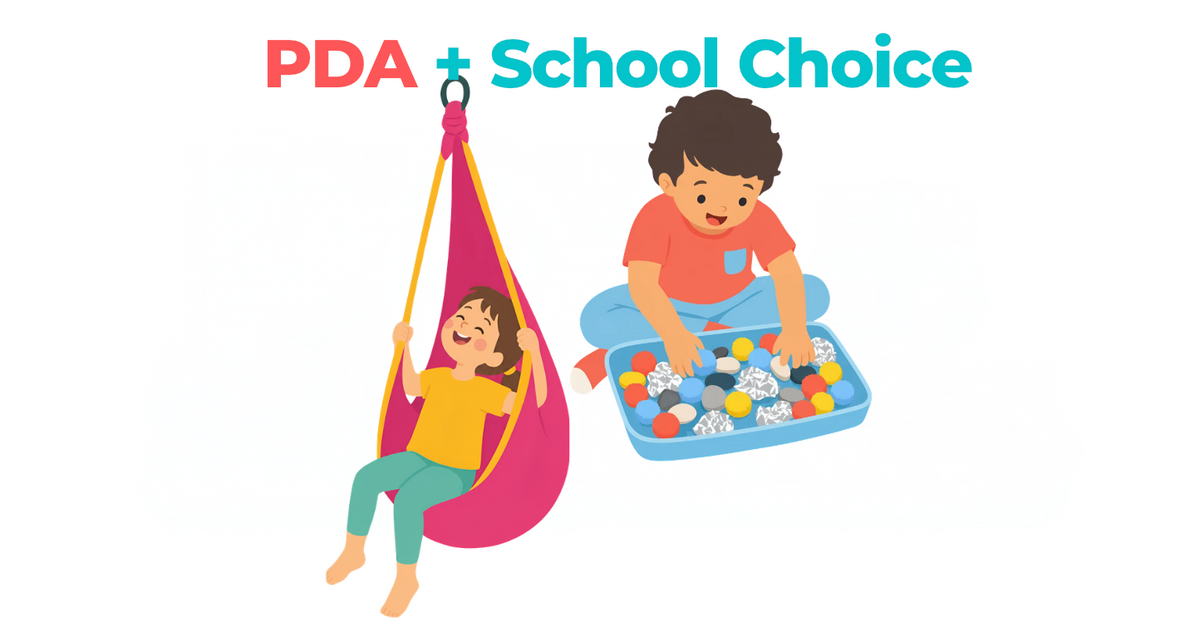
For most families, the question is which school. For a family raising a child with a PDA profile, the question is often much harder: whether traditional school is survivable at all. If you have watched a bright, funny, capable child fall apart at the classroom door, you already know that the usual advice does not fit. This is where school choice stops being a policy debate and becomes a lifeline.
What PDA actually is
PDA stands for Pathological Demand Avoidance, though a growing part of the community prefers the reframe Pervasive Drive for Autonomy, which captures the experience more kindly and more accurately. It describes a profile of autism in which a person avoids everyday demands to an extreme degree, not out of defiance, but out of an anxiety-driven, nervous-system-level need for control and autonomy.
The concept was first described by UK psychologist Elizabeth Newson, whose foundational paper was published in 2003. A demand can be almost anything: a teacher's instruction, a schedule, a transition, even a fun activity the child genuinely wants to do. The moment something becomes an expectation, anxiety spikes and avoidance kicks in. Children with a PDA profile often use social strategies to avoid demands, such as negotiating, distracting, or giving excuses, can appear sociable on the surface, tolerate very little of the ordinary pressure that school runs on, and swing quickly from calm to overwhelm.
It is worth being clear about the science. PDA is not a standalone diagnosis in the DSM-5, the DSM-5-TR, or the ICD-11. In the UK it is widely described, including by the PDA Society and the National Autistic Society, as a profile within the autism spectrum, and some UK clinicians write "autism with a PDA profile" in diagnostic reports. In the United States it has little formal clinical recognition, and its traits are often assessed instead under autism, anxiety, or oppositional defiant disorder. None of that makes the experience any less real for the families living it, but it does mean parents often have to advocate hard to be understood.
Why traditional school is so hard
Autism is more common than many people realize. The CDC's Autism and Developmental Disabilities Monitoring Network now estimates that 1 in 31 children aged 8, about 32.2 per 1,000, was identified with autism based on 2022 surveillance data published in 2025. That figure rose from the previous estimate of 1 in 36, based on 2020 data.
Anxiety commonly travels with autism, and for a child with a PDA profile, anxiety is the engine of the entire experience. Estimates vary depending on how studies are designed: a widely cited meta-analysis found that nearly 40 percent of autistic youth under 18 had at least one anxiety disorder, while a newer, broader review put the pooled estimate closer to 20 percent. Either way, anxiety is a major factor in the lives of a large share of autistic children.
Now picture a standard school day through that lens. It is a nearly unbroken sequence of demands, transitions, and social performance, in a loud, unpredictable environment, with very little room for autonomy. For a child whose nervous system reads demands as threats, this is not a matter of willpower or discipline. Research and advocacy organizations, including the PDA Society and peer-reviewed work on the educational experiences of these children, have documented high rates of school exclusion and school non-attendance among children with a PDA profile. The result is often a cycle of escalation, burnout, and shame that harms the child far more than any missed worksheet ever could.
Why school choice matters so much
There is no single "PDA school," because there is no single PDA child. What helps is options, and the freedom to change course when something is not working. School choice, including scholarship programs, homeschooling, microschools, and hybrid models, gives families the ability to build an environment around the child instead of forcing the child into an environment that hurts them.
For many PDA families, that flexibility is the whole ballgame. When a family can choose, they can leave a setting that is causing daily trauma, try a low-demand microschool, find a tutor who understands neurodivergence, or homeschool with curriculum and tools chosen specifically for how their child learns. The point is not that traditional school always fails. It is that families need real alternatives when it does.
Best practices for schooling, or unschooling, a PDA child
Whatever setting you choose, the same principles tend to make the difference:
Lead with the relationship. Trust and felt safety come before any academic goal. A regulated, connected child can learn. A child in fight-or-flight cannot.
Lower the demands. Reduce direct instructions and required outcomes, and notice how much learning happens once the pressure comes off. This is counterintuitive, and it works.
Use invitations, not commands. Wondering aloud, such as "I wonder what would happen if," lands very differently than "Now do this." Offer choices wherever you can, even small ones, so the child keeps a sense of control.
Follow the child's interests. Interest-led, or fully child-led, learning bypasses the demand trigger because the drive comes from within. A child obsessed with marine life can learn reading, math, and science through that single doorway.
Build in flexibility and recovery. Expect that some days hold more capacity than others. A plan that bends does not break.
Measure success by engagement, not completion. For a PDA learner, a curriculum that gets used flexibly and joyfully is worth far more than one completed to the letter.
This is also why unschooling, and interest-led homeschooling more broadly, fits so many PDA children. Removing the structure of demands is not the same as removing learning. Often it is the thing that finally lets learning back in, on the child's own terms and timeline.
How We Build for PDA at The Sensory Site
Everything above is easy to say and harder to find in an actual curriculum, which is why we build it into ours. At The Sensory Site, our PDA-aware curriculum guides are designed around invitation, not demand. Every activity includes an invitation-based alternative, so there is never a "the student will" requirement, only an open door the child can walk through in their own way and their own time. We replace questions with wondering aloud, we treat engagement as the goal instead of completion, and we include a visual choice board and connection strategies for hard days, so an adult always has a low-pressure option ready. We also honor sensory differences and consent throughout, because a child's no to a texture, a tool, or a task is always a complete answer. The goal is not to get a demand-avoidant child to comply. It is to give families and educators materials that meet the child where they are, so real learning can happen without the fight.
The bottom line
A child with a PDA profile is not a discipline problem to be managed. They are an anxious, autonomy-seeking learner whose brain is doing its best to stay safe. Given the right environment, one that offers low demands, genuine choice, and a trusted adult who gets it, these children can absolutely thrive. School choice is what makes finding that environment possible. For families who have spent years being told their child is the problem, the freedom to choose can feel less like a policy and more like a door finally opening.
References
CDC Autism and Developmental Disabilities Monitoring Network: Shaw KA, et al. "Prevalence and Early Identification of Autism Spectrum Disorder Among Children Aged 4 and 8 Years, Autism and Developmental Disabilities Monitoring Network, 16 Sites, United States, 2022." MMWR Surveillance Summaries, 2025.
van Steensel FJA, Bögels SM, Perrin S. "Anxiety Disorders in Children and Adolescents with Autistic Spectrum Disorders: A Meta-Analysis." Clinical Child and Family Psychology Review, 2011.
Lai MC, et al. "Prevalence of co-occurring mental health diagnoses in the autism population: a systematic review and meta-analysis." The Lancet Psychiatry, 2019.
PDA Society. Being Misunderstood: Experiences of the Pathological Demand Avoidance Profile of ASD, 2018.
Gore Langton E, Frederickson N. "Mapping the educational experiences of children with pathological demand avoidance." Journal of Research in Special Educational Needs, 2016.
Newson E, Le Maréchal K, David C. "Pathological demand avoidance syndrome: a necessary distinction within the pervasive developmental disorders." Archives of Disease in Childhood, 2003.
Share:
Meet Miss Jaeme!